Sunday, July 2, 2017

Mid-Year Resolutions | #MidYearResolutions

Re-Ignite Your Personal and Professional Development Goals


Welcome to the midpoint of 2017. Yep, the year is officially half over.


What’s happened to those New Year’s Resolutions you made a short six months ago? How many are on track? How many have you abandoned?


If you are disappointed in the answers to these questions, don’t be dismayed. Did you know that the failure rate of New Year’s Resolutions is over 80%. In fact, research shows that over 50% of all New Year’s Resolutions have been dropped by mid year.


Most people will wait until the beginning of the next new year to set personal resolutions and goals, simply because there is no social protocol suggesting they do otherwise. You can change this for yourself, as this video explains: 


Help us make Mid-Year Resolutions a new ritual by sharing this blog and the above video with your family and friends.


As for yourself (and them as well), we have two free articles on the Living A Determined Life website to help in making Mid-Year Resolutions:

·        


These two articles, combined with the Personal Change Action Plan tool that you will also find on our website, will help you kick-start your personal growth and self-development. They will also help you get those New Year’s Resolutions back on track, provided they are still relevant and meaningful to you.


Help spread the word with hashtag #MidYearResolutions.


Together we can help others also achieve their personal development goals. Now isn’t that a positive way to start the second half of the year?

Sunday, March 5, 2017

Overcoming Relationship Communications Breakdowns

If You Want to be Understood, First Show how Understanding You Can Be. 

Communication issues are frequently highlighted as a root cause of marital and relationship breakdowns. Often one partner accuses the other of not communicating. 
In fact, there is no such thing as not communicating. Even silence is a form of communicating. As is walking away.
All interpersonal communication has two components ── verbal and non-verbal. 
The words spoken are verbal. Everything else, including tone of voice, level of voice, gestures, body movements, facial expressions, and inflections comprise the non-verbal component. When the two are not in sync, the listener usually pays greater attention to (and assigns a higher value to) the non-verbal signals being received.
Partners in strong relationships accept that the other person's feelings are just as valid as their own. In troubled relationships at least one of the partners either does not hold this view or expresses it poorly. In destructive relationships neither partner holds the feelings of the other to be valid.
It is important to remember that there is no cause and effect relationship between what another person does or say and our feelings about such. Other people do not cause our feelings (though we often incorrectly assign blame for our feelings to others). 
Our feelings are not controlled or manipulated by anyone other than ourselves.
That's right. We have control over our feelings, even at times when this does not appear to be true. However we, and only we, can choose how to feel in response to any event, situation or utterance by another. These are our feelings, so we must take ownership and responsibility for them.
It is never correct to say "his action made me feel ­­­­________" or "her words caused me to feel ________." Rather, the correct phrases should be, "I chose to feel _______ because of what he did" and "I elected to feel _______ as my reaction to her words."
In any relationship (including workplace ones), but particularly in a married or de facto spousal relationship, we have a responsibility to communicate and respond to others in a non-violent and abusive-free manner. This is a joint responsibility of couples, and does not work as effectively if practiced by only one of the partners.

Far too much of the communication between partners and spouses is spent trying to get the other party to understand and accept what we want them to understand and accept. 
If you want to get through to your partner, you must first show that your partner can get through to you. 
In other words, if you want to be understood, first show how understanding you are. 

This article is partially excerpted from our top-ranked personal development book Project You: Living A Determined Life, which is available in Kindle and paperback formats at Amazon. 

Saturday, March 4, 2017

Making Marriages Work

7 Principles for Making Marriages Work

John Gottman, a leading researcher in marriage and parenting, and his co-author Nan Silver wrote a book called The Seven Principles for Making Marriages Work. Their list of seven principles can be summarized as:
Maintain a detailed map of your partner's inner and outer world by keeping current and up-to-date with their regular routines (daily/weekly/monthly), friends, enemies, hopes, desires, likes, dislikes, fears, enemies, challenges, stresses, deadlines, etc.
Continuously nurture fondness and admiration through your attitudes, actions and behavior. Frequently remind yourself of your partner's positive qualities, openly express these to others, and regularly compliment them for these qualities. Constantly be affectionate in little ways, especially those that you know are appreciated or enjoyed by your partner.
Turn towards one another instead of away, especially when your partner appears to want time, attention, affection, or support from you. Use humor and respect to connect with one another and do the little everyday things that touch and acknowledge one another.
Let your partner influence you by seeking common ground rather than on insisting things be done your way. Allow yourself to be "won over" by your partner's desires or wants, especially on things you can easily give on. Avoid belligerence and violence as these signal you cannot or will not be influenced.
Solve solvable problems quickly and readily before they fester into bigger issues.
Communicate and discuss perceived unsolvable problems rather than becoming gridlocked over these. Walking away from or not discussing these problems adds another problem to the situation ─ the fact that you are not communicating!
Create a shared meaning of life through discussions and create rituals, stories and symbols that build and express this shared meaning for the two of you.

Before you pick any of these principles and put them to work for you, we highly recommend you read The Seven Principles for Making Marriages Work.  Then, give all seven of these principles a try. 
In our next blog post we will share some tips on how to overcome some of the communications problems that typically plague relationships. 

This article is partially excerpted from our top-ranked personal development book Project You: Living A Determined Life, which is available in Kindle and paperback formats at Amazon. 

Tuesday, January 17, 2017

Forgiving Yourself Is Important

Self-Forgiveness is Healthy and Beneficial

We know that forgiveness is hard. 

Even harder for many people, is forgiving themselves for their actions, inaction, words, or thoughts. 

Interestingly, over 65% of the respondents in the Project You Global Survey on Forgiveness admitted that they have difficulties in forgiving themselves sometimes. In addition, another 14% responded that they "often" have difficulties in forgiving themselves. 

Only one in five respondents (21%) to our survey, who came from 18 different nationalities spread across the globe, said they have no difficulties in forgiving themselves. 

It seems that self-forgiveness is not a very common practice. 

The path to self-forgiveness is not often an easy one. In fact, even for those who are good at consistently forgiving others, forgiving one's self is often a more difficult task. 

In order to forgive ourselves, we have to be honest with ourselves and admit our mistakes and wrong actions. Plus, we have to take personal ownership for the wrongdoing. Trying to place blame elsewhere, or making excuses for our behavior, are not congruent with the self-forgiving process. 

On the other hand, not forgiving one's self and learning the lessons from one's misdeeds means to be shackled to the past and unable to move forward. It also extracts serious costs on our mental, emotional, and physical well-being. As Publilus Syrus wrote over two thousand years ago, "How unhappy is he who cannot forgive himself.

Personal Year of Forgiveness Starts With You

Regular readers of the Project You Life blog will know that we are encouraging everyone to make 2017 a Personal Year of Forgiveness. 


And one of the best places to start this personal program is with one's self. 

Through self-awareness and self-understanding, along with copious amounts of reflection and commitment, everyone can learn to forgive themselves and move beyond their past deeds and actions.

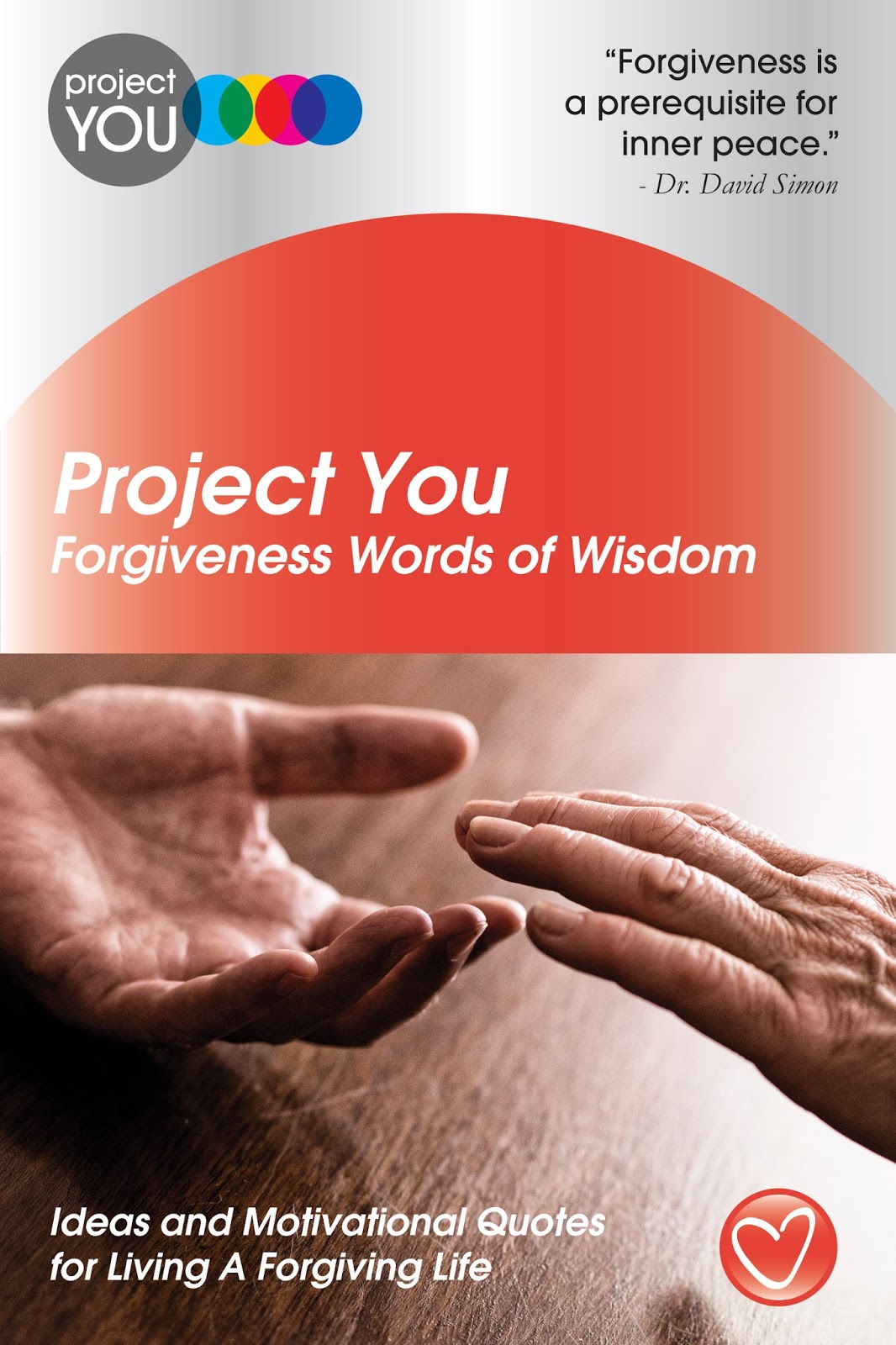
We have created a six-step process for forgiving yourself, which you will find in our latest book Project You: Forgiveness Words of Wisdom. The book launches tomorrow (January 18th) on Amazon in both paperback and Kindle formats. 

The ideas, techniques, and quotes in Project You: Forgiveness Words of Wisdom will assist you on your own journey to inner peace through forgiveness and to your own ability to Live A Determined Life. 

Forgive yourself. Let go of the past. Move on.

May this become your personal forgiveness mantra for 2917 and beyond. 


Monday, January 16, 2017

Forgiveness is Lacking in Families | Results from Global Survey on Forgiveness

Absence of Forgiving Prevalent in Family Relationships and Society 

We were stunned by one result in the 2016 Project You Global Survey on Forgiveness — 39% of the respondents said their own families were not forgiving at all, while another 16% said that their family members were not forgiving "very often." 

Admittedly, we had suspected that the lack of forgiveness is a major cause of family dysfunction. But we had not anticipated the severity of these results. 

With 55% of respondents indicating there is little or no forgiveness within their own families, it is little wonder that people do not feel there is sufficient forgiveness in the world today (88% of the respondents to our survey, who come from 18 different nationalities, agreed that there is not enough forgiveness in today's world). 

Contrast these results with the responses to our questions on forgiveness in the workplace and within the countries in which respondents lived.

While both country level and workplace level forgiveness were deemed to be highly situational, the level of forgiveness in each was remarkably higher than indicated for families. 

For instance, only 19% said forgiveness happens "not very often" and just 3% said forgiveness does not happen at all in the countries in which they live. So that's a 22% lack of forgiveness at the country level compared to the 55% within families.

As for the workplace, just over 14% said that forgiveness in the organizations in which they work happens "not very often" or "not at all." That's about one-fourth the level of the absence of forgiveness in families. 

You can download the full results of the survey here:  2016 Project You Global Survey on Forgiveness

Personal Year of Forgiveness 

The lack of forgiveness within families is one of the biggest ills of society. We had suspected that this may only be a problem in the materialized western world. But the responses were fairly consistent across all 18 different nationalities that responded to our global survey on forgiveness. 

We also see the lack of forgiveness occurring frequently in other aspects of today's world. We all witnessed the anger, fury, and antagonism that surrounded last year's Brexit vote and the lengthy U.S. election process. Numerous studies are also showing increased incivility in the workplace across the globe. 

Hence, Project You is calling for 2017 to be a Personal Year of Forgiveness

We want to start a dialogue on forgiveness. We want to encourage acts of forgiveness at the family, workplace, and national levels. 

We ask that you help start this dialogue by sharing this blog post and our two previous blog posts (Research Confirms Forgiving Is Difficult and Why Are We So Hesitant To Forgive?) with your family, friends, and colleagues. And please share these in Facebook, Twitter, LinkedIn, and elsewhere. 

And most important, please share with us and your fellow readers in the comments section below your own ideas on how we can stimulate a Personal Year of Forgiveness with everyone. 

Thank you. 


Sunday, January 15, 2017

Why Are We So Hesitant To Forgive?

To Forgive Is To Set Yourself Free

The Project You Global Survey on Forgiveness late last year confirms that there is a great deal of hesitancy to forgive. This reluctance to take action is one of the key hurdles preventing more forgiveness in the world, both in our personal and professional relationships. 

In this global survey on forgiveness, we asked participants what action they would take with regards to a person with whom they are currently in conflict. We gave three options: forgiveness, revenge, or do nothing. A full 35% of the respondents, who came from 18 different nationalities, chose the "do nothing" option. 

When asked what is holding them back from forgiveness, 31% indicated pride while another 30% said anger. 

Many people are afraid to forgive simply because somehow they feel they must remember the wrong, the hurt, and the paid they experienced in order to learn and retain the lessons from these. This is utter nonsense. 

There is no need for this. You can remember the lessons without having to hang on to the wrong done to you or to constantly suffer from recalling the agony you felt at the time and since. 

Likewise, forgiveness does not excuse the other person's behavior or words. Forgiveness does, however, prevent their behavior and words from razing your emotions, flattening your spirit, and destroying your heart.

This is why Lewis B. Smedes was so correct when he wrote: "To forgive is to set a prisoner free and discover that the prisoner was you."

Personal Year of Forgiveness 

Through our books, our blog, and a series of events we are planning, Project You is dedicated this year to helping people become more conscious of the power of forgiveness and more aware of the numerous benefits of living a forgiving life. 

As such we are also encouraging everyone to make 2017 a Personal Year of Forgiveness by incorporating forgiveness into everything you do, from your New Year's Resolutions and 2017 goal setting to your daily habits. 

Here's why: 
  • Practice forgiveness and you will find a higher level of inner peace and happiness. 
  • Practice forgiveness and you will increase your ability to love on all fronts. 
  • Practice forgiveness and you will become a better individual, partner, friend, parent, and even co-worker. 
Forgive. Let go. Move on.

May this become your personal mantra in 2017 and beyond. 


Saturday, January 14, 2017

Research Confirms Forgiving Is Difficult

Calling for a Personal Year of Forgiveness

Research conducted last year by Project You confirms that for many forgiveness is a difficult process and often not an easy thing to do. 

In our Global Survey on Forgiveness late last year, 45% of the respondents said their first instinctive response, if asked to forgive one person in their life right now, would be "no way." Another 6% expressed self-righteousness ("I didn't do anything wrong, I'm in the right here") and almost 5% indicated an angry response in line with "why should I be the one to forgive?" 

Additionally, when given a choice between forgiveness, revenge, or doing nothing with regards to a particular person with whom they are currently in personal or professional conflict with, 35% chose the "do nothing" option. 

We also asked "does the pain of your hurt or offense seem so great and personal that you find it difficult to share with others?" Almost 37% replied yes to this question. 

Our research project also confirmed that there is not enough forgiveness in the world today (88% of respondents from 18 different nationalities who took part in our survey agreed with this statement). 

There is no question that forgiving can be hard. Complete, unconditional forgiveness is even harder — sometimes even impossible — to grant. 

Extending forgiveness is one of the hardest things we can do, but it is absolutely essential for our mental, emotional, and spiritual well-being. 

As such, Project You is calling for a Personal Year of Forgiveness.

Personal Year of Forgiveness 

There is so much anger, fury and antagonism in today's world. We have all witnessed this with Brexit, the tonality of the U.S. election, and increasing incivility in the workplace across the globe. 

We are encouraging everyone to consider how they can intentionally be more forgiving, of both themselves and others, in 2017. 

Make this your Personal Year of Forgiveness. Add forgiveness to one of your key New Year's Resolutions or goals for the year. 

Become more conscious of the power of forgiveness and make a conscientious effort to become more forgiving....both in your personal life and in your workplaces. 

What can you do? 

Start by reading about the numerous benefits of forgiveness. Learn and practice the forgiveness techniques that have helped others. Choose one person to forgive before the end of this month and prepare a plan for how you will convey your forgiveness. Share your own ideas and thoughts in the comments box below. 

Marianne Williamson wrote, "The practice of forgiveness is our most important contribution to the healing of the world.

There are many parts of our world that need healing today. Let us each take the steps of forgiveness that will create progress in this healing. You can start by sharing this blog post in your social media channels and with your family, friends, and colleagues. 

Help us make 2017 everyone's Personal Year of Forgiveness.